1
Rows need two stars
Every row must finish with exactly two stars. Once a row has two, the rest of that row is excluded, and rows with only two open cells left usually demand immediate attention.

Бесплатная логическая головоломка с 2 звездами
Разместите по две звезды в каждой строке, каждом столбце и каждой области, не позволяя звездам соприкасаться.
How to Play
Place stars so each row, column, and outlined region contains exactly two stars. A marker is only a note; it never counts as a star. The puzzle is complete only when the counts and the no-touch rule are both satisfied. If you are new, read the board as three overlapping checklists: finish the rows, finish the columns, and finish each region without letting any two stars become neighbors.
Every row must finish with exactly two stars. Once a row has two, the rest of that row is excluded, and rows with only two open cells left usually demand immediate attention.
Column counts are just as strict. A star placement always changes both its row and its column, so a tempting cell is only legal when both lines can still finish with two stars.
Each outlined region also needs exactly two stars, no matter how bent or narrow the shape is. Region counting is often the fastest way to find forced pairs before rows look obvious.
Stars cannot touch horizontally, vertically, or diagonally. One confirmed star blocks all eight neighboring cells, which means spacing is as important as the final count.
Before placing anything, scan each row, column, and region for spaces that are already impossible. A clean first pass reduces the board without gambling.
A star should survive all three count systems and the no-touch rule. If one rule rejects it, it is not a move; mark the cell and keep the proof visible.
When a row, column, or region has two stars, every other cell in that unit can be marked out. This simple cleanup creates most of the next deductions.
Strategy
Good Star Battle solving is a steady loop: count the rows, columns, and regions, then clean up the cells blocked by confirmed stars. If the next move is not clear, look for the area with the fewest legal cells instead of guessing.
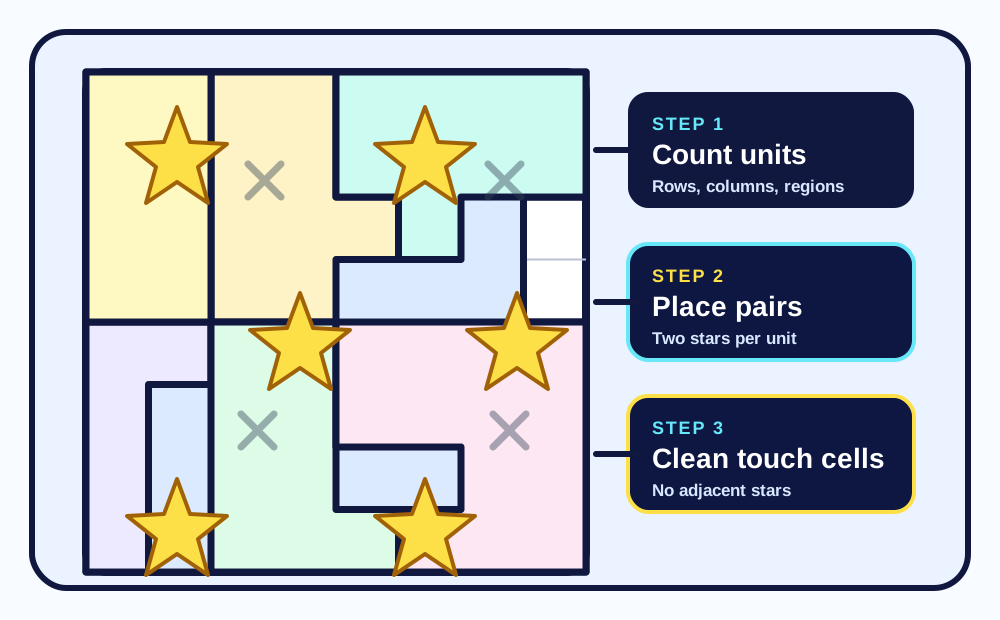
Start with the tightest region, compare its legal cells against the rows and columns, then mark every neighbor blocked by confirmed stars. Each pass should make the next count easier to read.
When a row, column, or region already has two stars, close the rest of that unit. This keeps the board readable and turns small deductions into the next forced pair.
Scan regions that have only a few realistic cells after row, column, and adjacency pressure. Skinny regions and boxed corners often expose the first forced pair.
Mark cells only when a rule excludes them. The board stays readable when every X has a reason, and mistakes are easier to audit when the reason is local.
In 2-star Star Battle, a row or region often resolves as a pair of cells instead of one obvious star. Treat paired options as useful structure, not unfinished work.
After placing a star, close nearby cells and recheck whether any row, column, or region has reached two. Most stalls come from skipping this cleanup pass.
What Is Star Battle
Star Battle looks simple because every move is a star or a marker, but the irregular regions create tight logical constraints. It is not a chess puzzle and not Queens; the target piece, count system, region shapes, and no-touch rule are Star Battle-specific. The appeal is that a single grid can be read many ways: as a set of row totals, as column balance, as region quotas, and as a spacing map.
The same grid is checked three ways: by rows, by columns, and by irregular regions. A move that helps one count but breaks another is not progress.
The no-touch rule turns a single star into a local exclusion pattern across side and corner neighbors. This creates chains of safe eliminations.
Region shapes matter. Long, thin, and boxed-in regions often create the strongest deductions because their legal cells are easier to exhaust.
Why Play
Star Battle works well online because every board rewards patient elimination. The interface keeps the grid central, the controls close, and destructive reset separate from normal solving, while the content below explains the rules without blocking play. Regular levels give a clear path for learning the 2-star pattern, daily packs create a repeatable habit, and unlimited practice gives you more boards when you want to keep sharpening the same skill.
A board can be played as a focused logic break without setup, downloads, ads, or account gates. Open the page, solve the grid, and leave when the logic is done.
Good Star Battle progress is explainable: count legal cells, place forced stars, then clean exclusions. The best solves leave a trail you can check afterward.
Replay levels, daily packs, and generated seeds all reward cleaner deductions instead of guesswork. Speed comes from sharper scanning, not random clicking.
Daily Pack and Unlimited Practice
Regular levels teach progression, daily mode gives a fixed 5-puzzle routine, and unlimited mode keeps seeded 2-star practice available when you want another board. Use the modes differently: regular levels are best for steady improvement, the daily pack is best for a contained session, and unlimited is best for drilling a specific board size until the solving rhythm feels natural.
Daily mode is built around five 2-star puzzles for a compact routine: solve one board, continue the pack, and compare your own consistency across the set. The pack format is useful because it gives enough variation to warm up, recover from a difficult grid, and notice which deductions you keep missing.
Unlimited mode gives fresh generated boards by seed, so practice does not end when the daily pack is finished. Choose 8x8 when you want a quick drill, move to 9x9 for denser counting, and use 10x10 when you want larger regions and longer deduction chains.
Guides
Read focused guides when you want more than the quick rule summary: first-board flow, exact 2-star constraints, beginner strategy for count-based solving, and neighboring logic puzzles to try next.
Learn the 2-star rules, the row and column count, region constraints, and the no-touch rule.
RulesA practical guide to checking rows, columns, regions, and diagonal contact without guessing.
StrategyStart with boxed regions, forced pairs, and marker cleanup before placing risky stars.
TipsCompare Queens, Sudoku, Nonograms, Hitori, Kakuro, and other neighboring grid puzzles.
FAQ
These answers stay on the concrete product scope: 2-star rules, daily 5 packs, unlimited seeded practice, browser play, and no invented social proof. If a question affects how you make a move on the board, the answer here should be specific enough to act on immediately.
Star Battle is a grid logic puzzle where stars must satisfy row, column, region, and no-touch rules at the same time.
This site focuses on 2-star Star Battle, so every row and every column must contain exactly two stars.
Yes. Each outlined region needs exactly two stars, even when the shape is irregular or spread across several rows.
No. Stars cannot share a side or a corner. Diagonal contact is still contact.
Stop placing stars and count possible cells instead. Look for rows, columns, or regions that have only two legal cells left, then mark every neighbor blocked by confirmed stars.
No, but they make the logic easier to inspect. A marker should mean a specific rule has eliminated that cell, not simply that the cell feels unlikely.
Daily mode is a five-puzzle Star Battle pack. It is meant for a fixed daily routine rather than a single isolated board.
Unlimited mode uses seeded practice boards so you can keep solving fresh 2-star puzzles or replay a known seed.
No. The game is playable in the browser. Sign-in is only for progress saving when the parent app provides it.
No. Star Battle uses row, column, region, and no-touch star placement rules; it is not a Queens reskin.