
Star Battle Rules Explained
A precise guide to 2-star Star Battle rules: two stars per row, column, and region, with no touching stars and no long-diagonal ban.
Star Battle
May 12, 2026
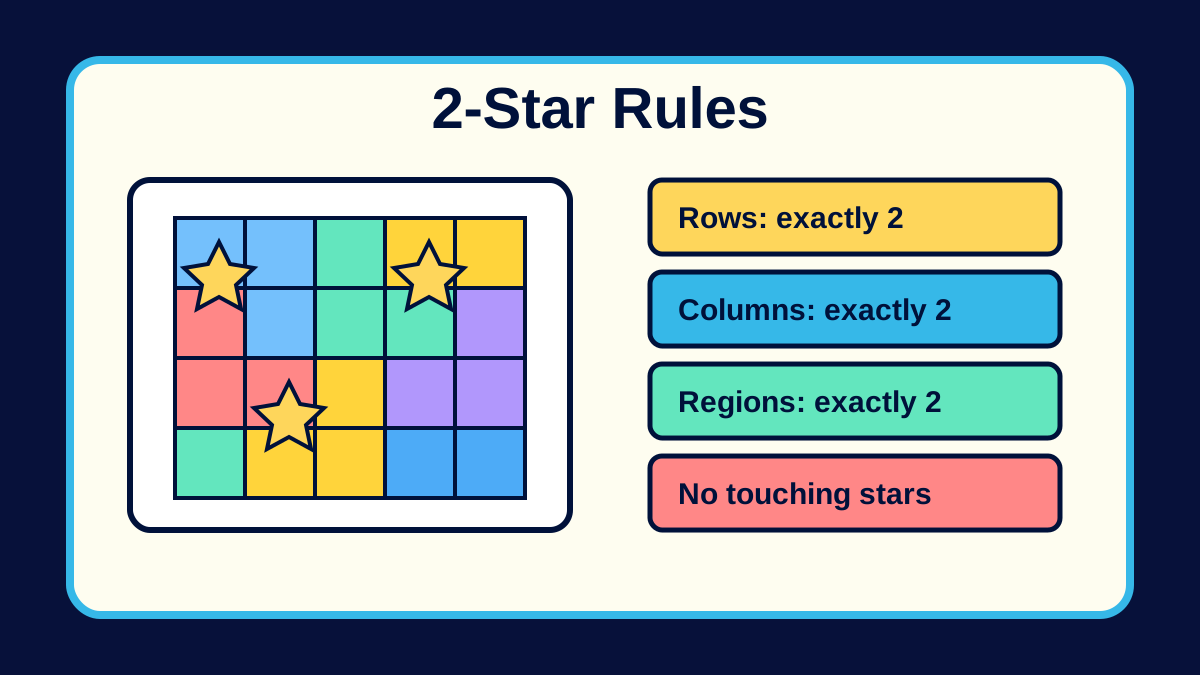
A precise guide to 2-star Star Battle rules: two stars per row, column, and region, with no touching stars and no long-diagonal ban.
2-star Star Battle is built from three counting rules and one spacing rule. A valid solution must satisfy all four. If any row, column, or region has the wrong number of stars, or if any pair of stars touches, the board is not solved.
This article explains the rules in a strict way because small misunderstandings create large solving mistakes. The most common errors are using one-star counts on a two-star board, treating regions as background color, or banning full diagonals as if stars were chess queens.
Rules at a Glance
| Rule | Requirement | Useful consequence |
|---|---|---|
| Rows | Exactly two stars per row. | A row with two stars makes all other cells in that row impossible. |
| Columns | Exactly two stars per column. | A column with two stars makes all other cells in that column impossible. |
| Regions | Exactly two stars per outlined region. | A region with two stars makes all other cells in that region impossible. |
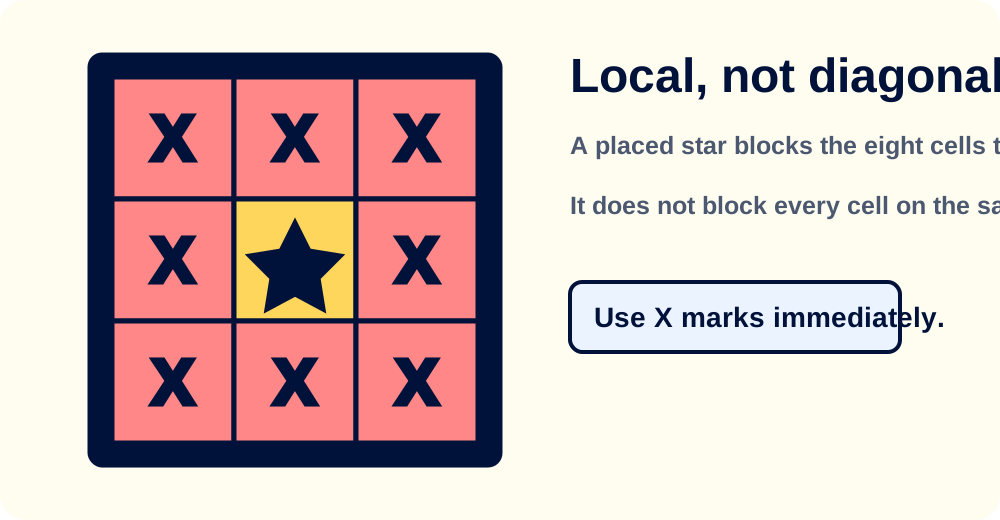
| No-touch | Stars cannot share a side or a corner. | A placed star blocks up to eight neighboring cells. |
Row Rule
Every horizontal row must contain exactly two stars. Not one, not three, and not two plus a maybe. The row is complete only when two actual stars have been placed.
The row rule is useful in both directions. If a row already has two stars, mark the rest of the row X. If a row still needs two stars and has only two legal cells left, both cells are forced stars.
Column Rule
Columns use the same two-star count. Many players scan rows more naturally than columns, so column mistakes are common. Rotate your attention: after each placement, check the row, then the column, then the region.
Column pressure becomes stronger when combined with regions. If a region's only candidates lie in two columns, those columns may be reserved for that region's two-star quota, eliminating candidates from other regions in the same columns.
Region Rule
Each outlined region must also contain exactly two stars, regardless of its size or shape. A large bent region and a compact rectangular region both need the same number of stars.
Regions are the main reason Star Battle feels different from simple row-column placement. Their shapes create bottlenecks, locks, and forced pairs. A region with exactly two legal cells left is solved immediately. A region whose candidates are trapped in two rows or columns creates line pressure even before the exact star cells are known.
What Counts as Touching?
Touching means sharing an edge or a corner. Horizontal neighbors touch. Vertical neighbors touch. Diagonal neighbors touch. Therefore any 2 by 2 block can contain at most one star.
The rule does not ban an entire diagonal. Two stars may sit on the same long diagonal if they are not adjacent and if all row, column, and region counts remain correct. This is a major difference from chess-queen logic.
What Counts as a Valid Solution?
A solved 2-star Star Battle board must pass four audits:
- Every row has exactly two stars.
- Every column has exactly two stars.
- Every outlined region has exactly two stars.
- No two stars touch horizontally, vertically, or diagonally.
If a board passes only three of the four audits, it is not solved. In practice, that means you should not trust a row-perfect board until the regions and adjacency are checked too.
Is 2-Star the Standard Format?
Star Battle can be played with different star counts. Puzzle references often describe the general rule as N stars per row, column, and region, and 2-star boards are a common standard format, especially on larger grids. Starbattle.online uses the 2-star format as its default product because it gives enough density for interesting deductions while staying readable in the browser.
Sources and Notes
The general Star Battle rule family is documented by Puzzle Wiki, Logic Puzzle Wiki, and World Puzzle Federation-style instruction booklets. This article narrows those general rules to the 2-star version used on this site.
FAQ
Is this the one-star version?
No. This site is built around 2-star Star Battle.
Do regions have to contain two stars too?
Yes. Rows, columns, and regions all use the same two-star count.
Do long diagonals matter?
No. Only adjacent diagonal contact is banned. Long diagonal alignment is not automatically illegal.
Why does two-star play feel harder?
Because each unit has a quota of two, not one. You must reason about pairs, locks, and remaining capacity instead of simply finding a single placement.
Related Guides
How to Play Star Battle
Learn the 2-star Star Battle rules, the empty-X-star click flow, and a clean first-board workflow for solving without guessing.
Star Battle Strategy for Beginners
Beginner-friendly 2-star Star Battle strategy using counting, completed-unit cleanup, 2x2 limits, locked regions, and short contradiction checks.
Logic Puzzles Like Star Battle
A guide to logic puzzles like Star Battle, including Queens, Sudoku, Nonograms, Hitori, Kakuro, and Minesweeper-style local constraint puzzles.