
Star Battle Strategy for Beginners
Beginner-friendly 2-star Star Battle strategy using counting, completed-unit cleanup, 2x2 limits, locked regions, and short contradiction checks.
Star Battle
May 12, 2026
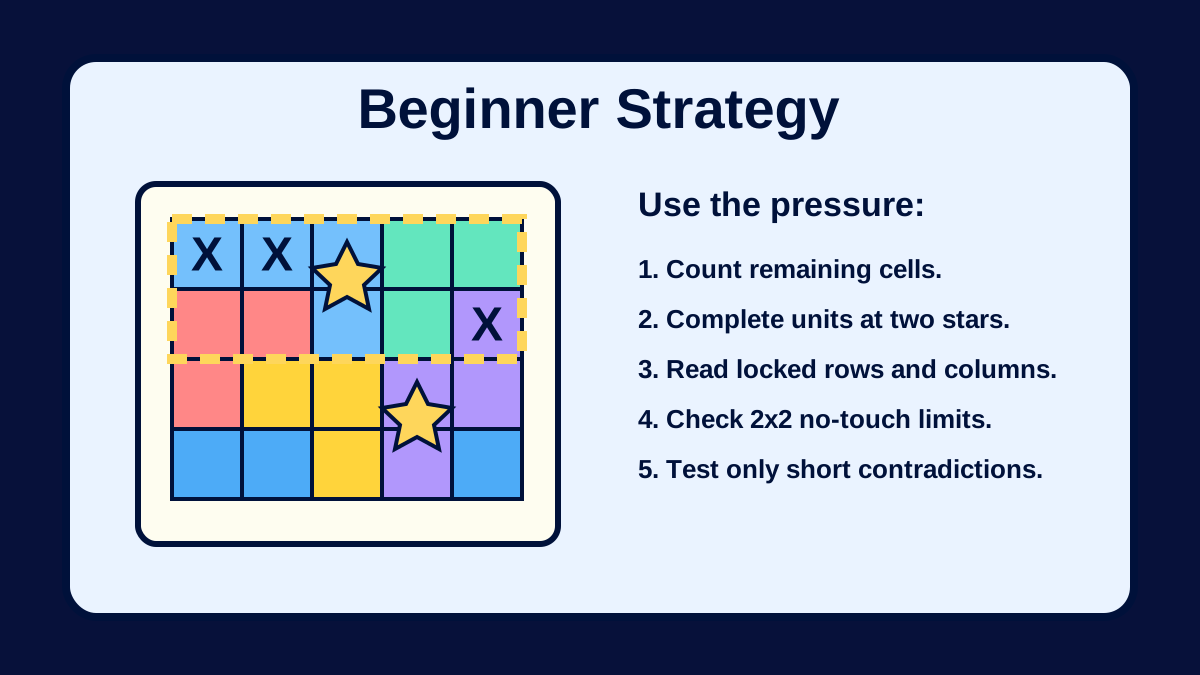
Beginner-friendly 2-star Star Battle strategy using counting, completed-unit cleanup, 2x2 limits, locked regions, and short contradiction checks.
Good Star Battle strategy is not memorizing decorative shapes. It is accurate counting under pressure. Every row, column, and region needs exactly two stars, and every star blocks its neighbors. The puzzle advances when those facts squeeze a unit until only one outcome remains.
Use the techniques below in order. The early ones are cheap and reliable. The later ones are still logical, but they require a cleaner board and more careful auditing.
The Core Strategy Loop
- Count legal cells. A row, column, or region with exactly two legal cells must use both.
- Clean completed units. Once a unit has two stars, mark the rest of that unit X.
- Apply no-touch cleanup. Mark all side and corner neighbors around every star.
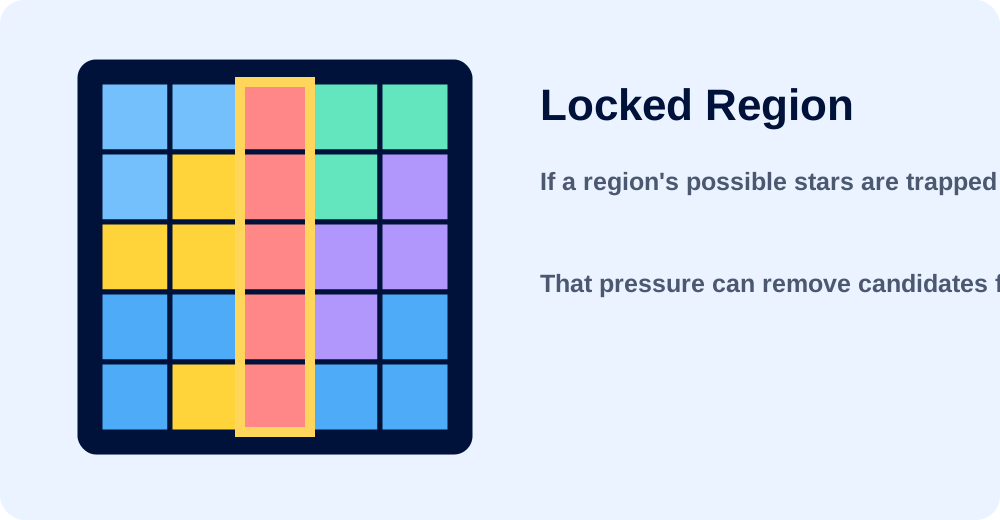
- Look for locks. Candidate groups trapped in two rows or two columns can reserve those lines.
- Use short tests only when stuck. A useful contradiction test should quickly produce a row, column, or region with too little space.
1. Count Before You Place
The strongest beginner question is: which unit is nearly out of room? If an eight-cell region has six cells marked X, the last two legal cells are both stars. If a row needs two stars and only two cells remain possible after region and adjacency checks, the row is solved.
Count legal cells, not empty-looking cells. A cell can be empty visually but impossible because it touches a star, belongs to a completed region, or sits in a completed column.
2. Use Completed Units Hard
A completed unit is free information. When a row reaches two stars, every other cell in that row becomes X. The same is true for columns and regions.
Beginners often underuse this because the placement itself feels like progress. The real progress is the cleanup. A single completed row can remove candidates from several regions. A completed region can finish a column. Cleanup is where chains begin.
3. Treat 2x2 Blocks as Dangerous
Because stars cannot touch diagonally, any 2 by 2 block can contain at most one star. This tiny fact creates many practical eliminations.
If a star is forced into one of two adjacent cells, then cells beside that pair may be impossible because either possible star would touch them. If two stars must be placed across a short lane, the no-touch rule can force them to spread apart in a very specific pattern.
4. Find Region Locks
A lock appears when a region's remaining candidates are restricted to a small set of rows or columns. In a 2-star puzzle, if a region's two stars must both come from the same two columns, those columns are partly claimed by that region.
The simplest version is direct: a region has exactly two legal cells, both in the same row. Those cells are stars, and the row is now closer to completion. The more advanced version is indirect: several candidates remain, but all of them sit inside two rows. You may not know the exact stars yet, but you know where the region's quota must live.
5. Use Row and Column Pair Pressure
Two rows together need four stars. Two columns together need four stars. That combined count can be useful when regions are tangled across the same small band of cells.
For example, if two neighboring rows already contain three forced stars, every remaining candidate in those rows must be checked against the single remaining slot. If a region tries to demand two more stars in the same rows, something must give. This is not advanced theory; it is bookkeeping.
6. Keep Contradiction Tests Short
A contradiction test is not a guess when it is controlled. Pick a highly constrained candidate, temporarily treat it as a star, perform immediate cleanup, and look for a concrete failure: a row, column, or region that can no longer reach two stars.
If the test keeps branching, stop. Long speculative chains are expensive and error-prone. Go back to counting, completed-unit cleanup, and locks.
Common Strategy Mistakes
Placing before marking
Put X marks down first. Stars should arrive after the board has been reduced, not before.
Checking rows and columns but not regions
A row-perfect solution can still be wrong. Regions carry the same two-star requirement.
Missing local adjacency
Do not only scan left, right, up, and down. The four diagonal neighbors matter too.
Testing because the board feels hard
Difficulty is not evidence. Test only when direct logic has stalled and the candidate is tight enough to produce a short proof.
Practice Plan
- One board for counting: before each star, name the row, column, or region that forced it.
- One board for cleanup: after each star, mark neighbors and completed units immediately.
- One board for locks: scan all regions for candidates trapped in two rows or two columns.
- One board without testing: force yourself to solve by counting and marking only.
- One audit board: after completion, verify every row, column, region, and no-touch pair.
FAQ
What is the best first habit?
Count legal cells in constrained rows, columns, and regions before placing stars.
What should I do when stuck?
Switch to marking mode. Completed-unit cleanup, no-touch cleanup, and region locks often reveal the next forced pair.
Should I guess?
Blind guessing is not a strategy. A short contradiction check is acceptable when it produces a specific failure.
Why is a 2 by 2 block important?
Because any two cells inside that block touch by side or corner, so the block can contain at most one star.
Related Guides
How to Play Star Battle
Learn the 2-star Star Battle rules, the empty-X-star click flow, and a clean first-board workflow for solving without guessing.
Star Battle Rules Explained
A precise guide to 2-star Star Battle rules: two stars per row, column, and region, with no touching stars and no long-diagonal ban.
Logic Puzzles Like Star Battle
A guide to logic puzzles like Star Battle, including Queens, Sudoku, Nonograms, Hitori, Kakuro, and Minesweeper-style local constraint puzzles.