
How to Play Star Battle
Learn the 2-star Star Battle rules, the empty-X-star click flow, and a clean first-board workflow for solving without guessing.
Star Battle
May 12, 2026
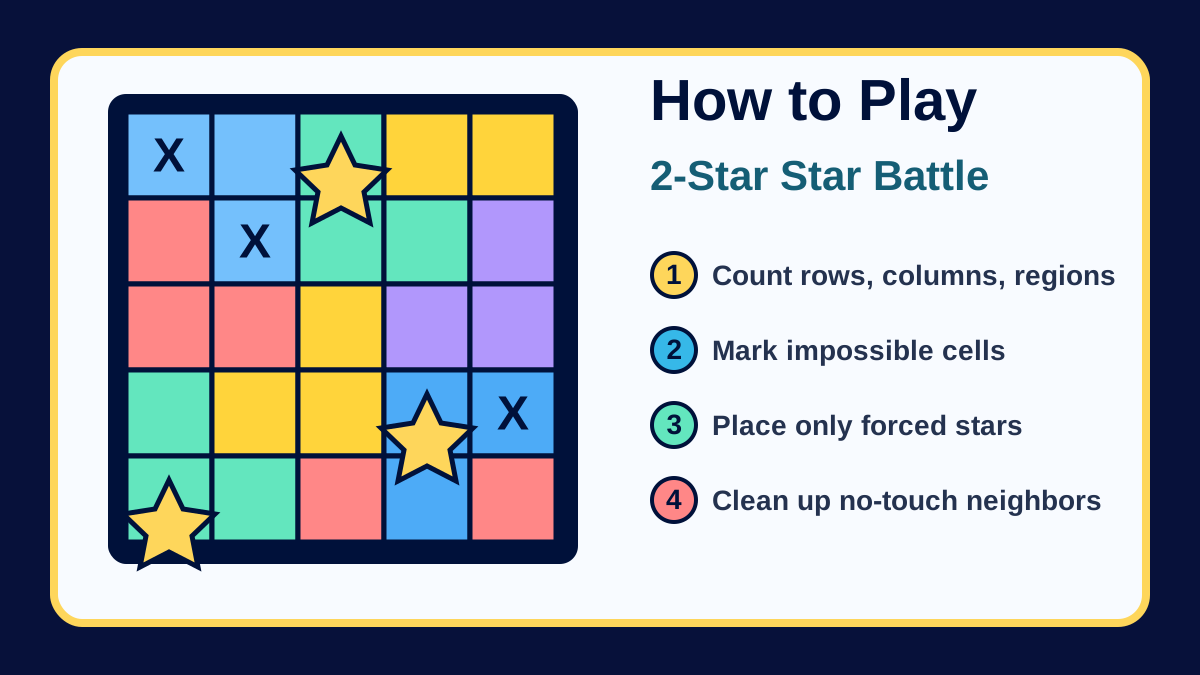
Learn the 2-star Star Battle rules, the empty-X-star click flow, and a clean first-board workflow for solving without guessing.
Star Battle is a grid logic puzzle about placing stars under several overlapping constraints. On this site the default format is 2-star Star Battle: every row, every column, and every outlined region must contain exactly two stars, and no two stars may touch, even at a corner.
The rules are short enough to learn in a minute. The hard part is learning to treat every mark as evidence. A good solve is not a string of lucky star placements. It is a repeatable cycle: count the available cells, mark what cannot work, place only forced stars, then clean up the consequences.
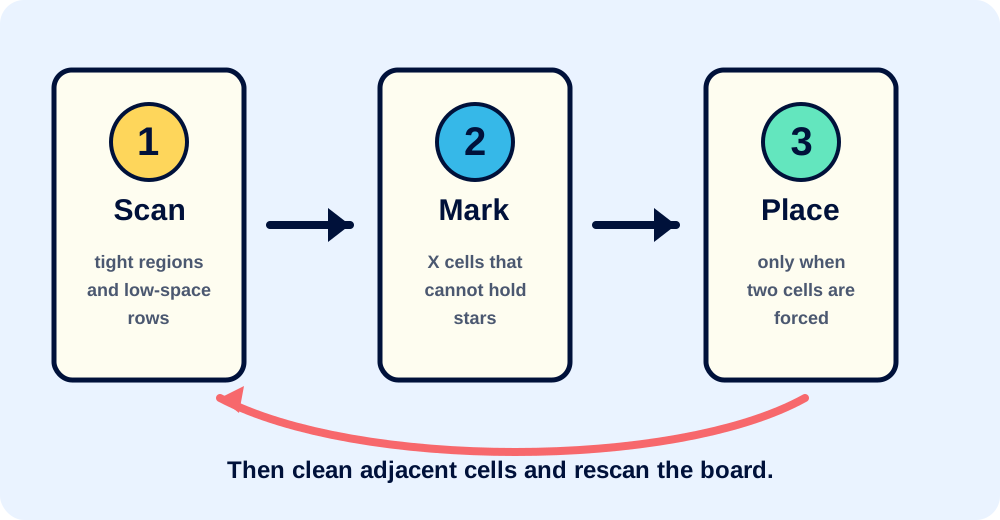
The Four Rules
- Each row contains exactly two stars. Once a row has two stars, every other cell in that row can be marked X.
- Each column contains exactly two stars. The vertical count is just as strict as the row count.
- Each outlined region contains exactly two stars. Region borders are puzzle information, not decoration.
- Stars cannot touch. Two stars may not share a side or a corner, so a placed star blocks up to eight neighboring cells.
Those rules must all be true at the same time. A row can look finished while a region is still short. A region can have two stars while one of them touches a diagonal neighbor and makes the board invalid. Never validate one rule in isolation.
The Click Flow on This Site
The board uses a direct click cycle: empty cell, X marker, star, empty cell. X means the cell is not a star. The marker is a note for your reasoning; it does not count toward row, column, or region totals.
This flow keeps solving close to the board. You do not need to switch between a star tool and a marker tool. Click once when you know a cell is impossible, click again when the board proves a star, and click again if you need to clear a mistaken note.
How to Start Your First Board
Start with the tightest parts of the grid. Look for small regions, narrow regions, and rows or columns that already have many cells blocked by the no-touch rule. You are not looking for the prettiest place to put a star. You are looking for a unit that is running out of legal space.
If a region has exactly two legal cells left, both cells must be stars. If a row has two stars, the rest of the row becomes X. If a column has one star and only one other legal cell left, that remaining cell must complete the column.
After every star, do cleanup before hunting elsewhere. Mark every touching neighbor. Then mark any completed row, column, or region. This cleanup often creates the next forced pair without any additional guessing.
A Small Worked Example
Imagine a region with six cells. Four are already blocked by completed rows and diagonal contact from nearby stars. The region still needs two stars. Since exactly two legal cells remain, both are forced.
Now suppose those two forced stars complete their row and one column. The row's remaining cells become X. The completed column's remaining cells become X. The neighboring cells around each star become X. One of those new marks may reduce a different region to two legal cells, giving you another forced pair.
This is the rhythm of Star Battle. You do not solve the whole board at once. You let one confirmed count damage the surrounding space, then you rescan the damaged rows, columns, and regions first.
Beginner Checklist
- Count legal cells in the smallest regions before placing any star.
- Use X marks aggressively when a cell is impossible.
- Place stars only when a row, column, or region forces the exact count.
- After every star, mark all eight possible neighboring cells.
- After any row, column, or region reaches two stars, mark the rest of that unit.
- Rescan the area affected by your last move before jumping across the board.
- Use short contradiction checks only when direct counting stops.
Common Beginner Mistakes
Thinking in one-star rules
Some Star Battle variants use one star per row, column, and region. This site uses the 2-star format, so every completed row, column, and region must hold exactly two stars.
Forgetting diagonal contact
Diagonal neighbors touch. If two stars sit corner-to-corner, the board is invalid even if their rows, columns, and regions look fine.
Keeping impossible cells in your head
Do not rely on memory. X marks make the board honest. They also expose units with exactly two legal cells left.
Guessing from a balanced-looking cell
A cell that looks centered or symmetrical is not evidence. Count first. Guessing early usually hides the deduction the puzzle is trying to teach.
Five-Board Practice Plan
- Board 1: say the four rules before every star placement.
- Board 2: after every star, clean row, column, region, and neighbors before doing anything else.
- Board 3: start every scan with regions, not rows.
- Board 4: solve with X marks first and delay star placements until forced.
- Board 5: finish normally, then audit every row, column, region, and adjacent pair.
Further Reading
For background on the puzzle genre, see the Star Battle entries at Puzzle Wiki and Logic Puzzle Wiki. This site's instructions are written for the 2-star version used here.
FAQ
How many stars go in each row?
Exactly two stars go in each row, each column, and each outlined region.
Can stars touch diagonally?
No. Stars cannot touch horizontally, vertically, or diagonally.
Does an X count as a star?
No. X is only a note that says a cell cannot contain a star.
Do I need an account?
No. You can play as a guest. When site-specific Google sign-in is configured, signing in is only for preserving progress across browsers and devices.
Related Guides
Star Battle Rules Explained
A precise guide to 2-star Star Battle rules: two stars per row, column, and region, with no touching stars and no long-diagonal ban.
Star Battle Strategy for Beginners
Beginner-friendly 2-star Star Battle strategy using counting, completed-unit cleanup, 2x2 limits, locked regions, and short contradiction checks.
Logic Puzzles Like Star Battle
A guide to logic puzzles like Star Battle, including Queens, Sudoku, Nonograms, Hitori, Kakuro, and Minesweeper-style local constraint puzzles.