
Logic Puzzles Like Star Battle
A guide to logic puzzles like Star Battle, including Queens, Sudoku, Nonograms, Hitori, Kakuro, and Minesweeper-style local constraint puzzles.
Star Battle
May 12, 2026
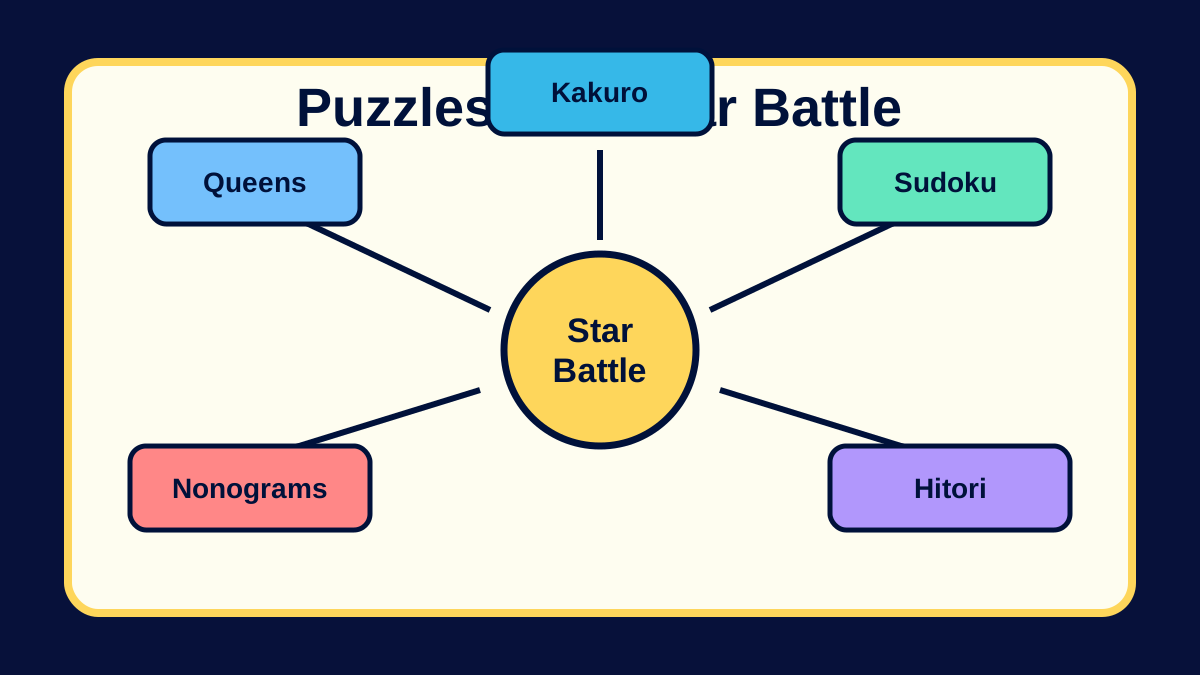
A guide to logic puzzles like Star Battle, including Queens, Sudoku, Nonograms, Hitori, Kakuro, and Minesweeper-style local constraint puzzles.
If you like Star Battle, you probably enjoy puzzles where a small rule set creates a large amount of deduction. The satisfying part is not hidden trivia or fast reflexes. It is watching rows, columns, regions, and local restrictions narrow the board until one move becomes unavoidable.
The puzzles below train neighboring skills. Some are close relatives. Others feel different on the surface but reward the same habits: marking impossibilities, counting remaining space, and refusing to guess until a constraint proves something.
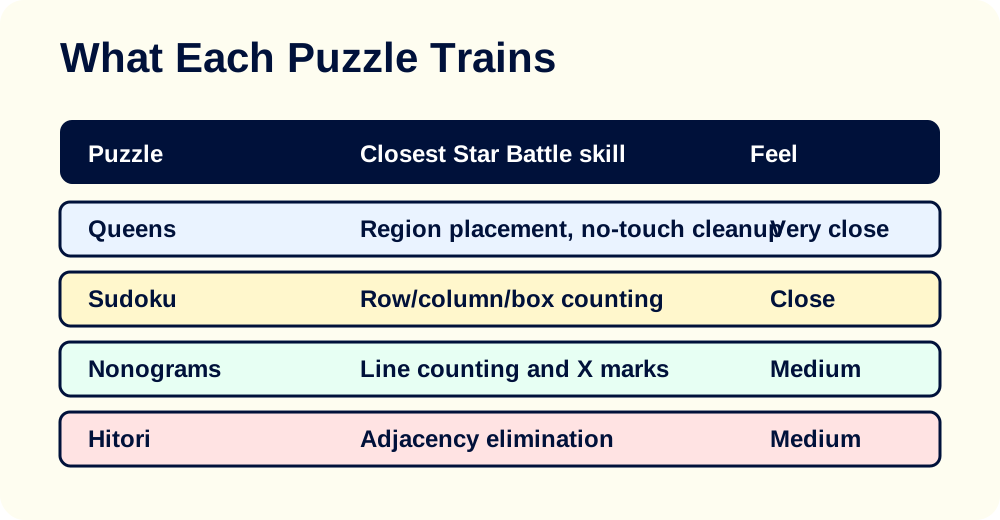
Quick Comparison
| Puzzle | Feels close to Star Battle? | Main shared skill |
|---|---|---|
| Queens | Very close | Region placement and no-touch cleanup |
| Sudoku | Close | Row, column, and box constraints |
| Nonograms | Medium | Line counting and X-mark discipline |
| Hitori | Medium | Elimination plus adjacency rules |
| Kakuro | Medium | Quota logic and combinations |
| Minesweeper | Medium | Local neighbor constraints |
Queens
Queens is the closest relative for many players. It uses a grid, regions, and a no-touch rule. The biggest difference is count density: modern Queens-style boards often use one piece per row, column, and region, while this site uses two stars per row, column, and region.
Skills transfer well. If you know how to clean up adjacent cells, read region pressure, and avoid full-diagonal chess assumptions, Queens will feel familiar. Star Battle adds pair counting, so you must reason about two required placements rather than one.
Sudoku
Sudoku replaces stars and regions with digits and boxes, but the core discipline is similar. Each number must satisfy row, column, and box constraints. A candidate becomes forced when the unit has no other place to put it.
Star Battle players often adapt well because they already understand candidate marking. The main shift is that Sudoku has several symbols, while Star Battle has one piece type and a stricter local spacing rule.
Nonograms
Nonograms are picture logic puzzles built from row and column clues. They do not use regions, but they strongly reward line counting and marking impossible cells. That makes them a good training ground for Star Battle's X-mark workflow.
If you enjoy proving that a cell cannot contain a star before you know where every star goes, Nonograms will feel natural. The same patient marking habit carries across.
Hitori
Hitori asks players to shade cells so duplicate numbers are resolved, shaded cells do not touch orthogonally, and unshaded cells remain connected. It is less visually similar to Star Battle, but it trains elimination and adjacency awareness.
The key overlap is local consequence. One shaded cell changes the status of neighboring cells, just as one star blocks its adjacent cells in Star Battle.
Kakuro
Kakuro is more arithmetic-heavy. It uses sums and non-repeating digit combinations instead of stars. The shared skill is quota reasoning: a run needs a precise set of values, and every candidate must serve that total.
Choose Kakuro if you want number combinations. Choose Star Battle if you prefer spatial placement without arithmetic.
Minesweeper and Local Constraint Puzzles
Minesweeper is not always a pure logic puzzle because some positions can require probability. Still, its local number clues train the same habit of reading neighbors. A number tells you how many surrounding cells contain mines; a star tells you every surrounding cell cannot contain another star.
The important difference is expectation. A well-designed Star Battle board should be solvable by logic. In Minesweeper, probability sometimes becomes part of play.
What Should a Star Battle Player Try Next?
- Want the closest rule feel? Try Queens.
- Want classic candidate logic? Try Sudoku.
- Want more line counting? Try Nonograms.
- Want adjacency-heavy elimination? Try Hitori.
- Want arithmetic constraints? Try Kakuro.
Why Star Battle Stands Out
Star Battle is unusually compact. One symbol, one marker, three count systems, and one no-touch rule are enough to create deep boards. That makes it easy to start but demanding to solve cleanly.
The 2-star format adds a special rhythm. You are rarely looking for a single isolated placement. You are looking for pairs, capacity, locks, and cleanup chains. That is what gives Star Battle its identity among grid logic puzzles.
FAQ
What puzzle is most similar to Star Battle?
Queens is usually the closest because it also combines regions, placement, and no-touch logic.
Will Sudoku skills help?
Yes. Candidate discipline, row-column scanning, and unit completion all transfer well.
Does Star Battle require math?
No arithmetic beyond counting to two is required. The challenge is spatial logic and constraint tracking.
What should I play after finishing a daily pack?
Use unlimited seeded practice for more Star Battle, or try Queens and Nonograms if you want adjacent logic styles.
Related Guides
How to Play Star Battle
Learn the 2-star Star Battle rules, the empty-X-star click flow, and a clean first-board workflow for solving without guessing.
Star Battle Rules Explained
A precise guide to 2-star Star Battle rules: two stars per row, column, and region, with no touching stars and no long-diagonal ban.
Star Battle Strategy for Beginners
Beginner-friendly 2-star Star Battle strategy using counting, completed-unit cleanup, 2x2 limits, locked regions, and short contradiction checks.