
Star Battle vs Queens
Compare Star Battle and Queens: shared grid logic, different piece counts, region pressure, no-touch rules, and solving habits.
Star Battle
May 13, 2026
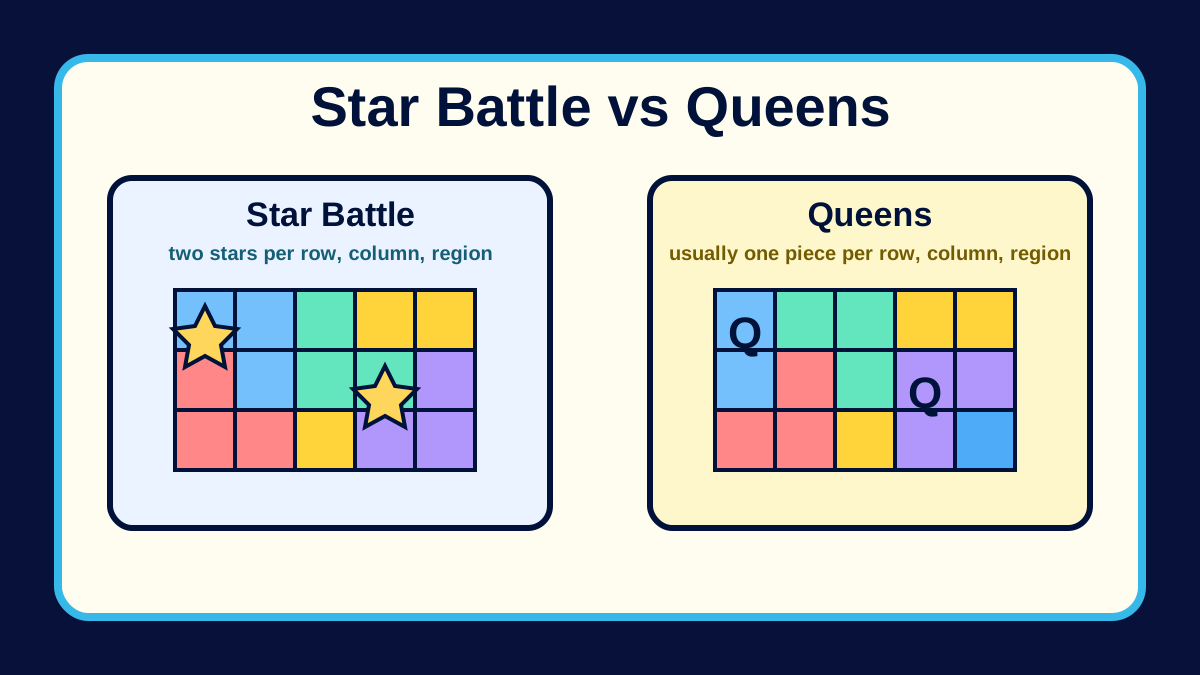
Compare Star Battle and Queens: shared grid logic, different piece counts, region pressure, no-touch rules, and solving habits.
Star Battle and Queens feel related because both are grid placement puzzles with regions and a no-touch rule. That similarity is real, but treating one as a simple reskin of the other leads to bad solving habits.
The practical difference is count density. Queens-style boards usually ask for one piece in each row, column, and region. The Star Battle format used here asks for two stars in every row, column, and region. That changes the entire rhythm of the solve.
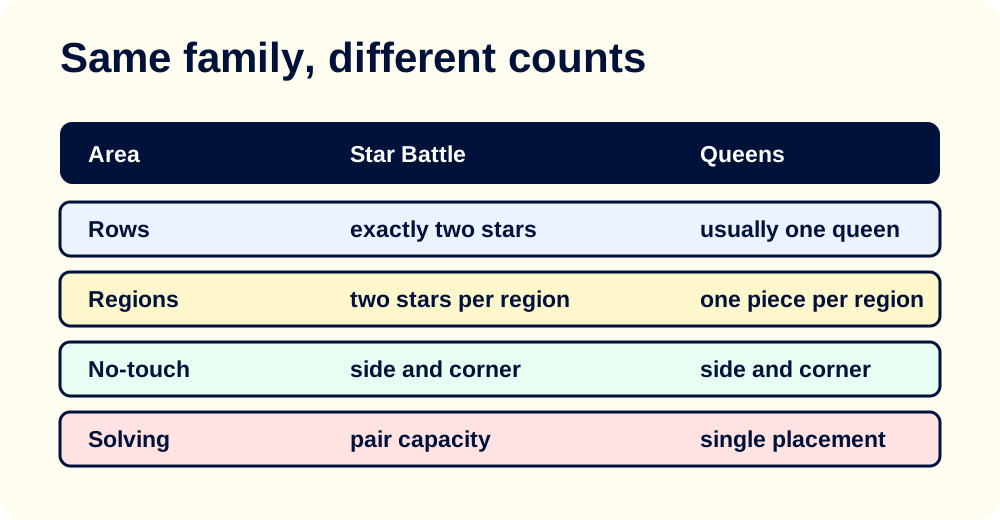
Quick Comparison
| Area | Star Battle | Queens |
|---|---|---|
| Pieces | Stars | Queens or queen-like markers |
| Rows | Exactly two stars per row on this site | Usually exactly one piece per row |
| Columns | Exactly two stars per column | Usually exactly one piece per column |
| Regions | Exactly two stars per region | Usually exactly one piece per region |
| Touching | No side or corner contact | No side or corner contact |
Skills That Transfer
The strongest transferable skill is cleanup. In both puzzles, a placed piece immediately damages nearby cells. You mark the row, column, region, and touching neighbors, then rescan the area that changed.
Region pressure also transfers. If a region's candidates are trapped in one part of the board, that shape creates row and column consequences before the exact piece is known.
What Changes in Star Battle
Two-star play is not just "Queens with more pieces." Every unit has capacity. A row can hold one star and still need another. A region can be half complete. Two rows together need four stars, and that combined count can matter.
This means Star Battle often asks you to reason about pairs. You look for two remaining legal cells, two-column locks, two-row traps, and 2x2 no-touch limits. The best move is often not a single star; it is a cleanup that proves where a pair must live.
Common Transfer Mistakes
Stopping after one star
In Star Battle, one star in a row does not complete the row. Keep counting until the second star is placed.
Ignoring remaining capacity
A column with one star and one legal cell left is forced. A column with one star and four legal cells is not.
Using chess diagonals
Neither modern Queens-style no-touch logic nor this Star Battle format bans whole diagonal lines. Only adjacent diagonal contact is banned.
Which Puzzle Is Harder?
They are hard in different ways. Queens is often about finding the one cell that satisfies several constraints. Star Battle is more about preserving enough capacity for two stars in every unit while adjacency removes space around each placement.
If you like clean single-placement deductions, Queens may feel sharper. If you like pair counting, pressure bands, and denser boards, 2-star Star Battle offers more room for that style of reasoning.
A Transfer Example
Suppose a Queens player sees a compact region with only two open cells. In Queens, that does not immediately solve the region unless the rule count is one and one of the cells is forced by another constraint. In 2-star Star Battle, the same shape may be decisive: if the region still needs two stars and exactly two legal cells remain, both cells are stars.
Now reverse the situation. A row already contains one piece. In Queens, the row is complete. In Star Battle, the row is only half complete, so clearing the rest of the row would be wrong. The next deduction is not "this row is closed"; it is "this row has one remaining slot." That slot can become powerful later when regions compete for the same row.
How to Switch Your Solving Habits
- Replace yes/no thinking with capacity thinking. Ask how many stars a unit still needs.
- Delay full cleanup until the count is complete. One star in a row does not clear that row.
- Keep using no-touch cleanup immediately. Contact rules apply after every single star.
- Scan regions as quotas. A region can be empty, half complete, or complete.
- Use pairs deliberately. Two remaining legal cells in a unit are often more important than one attractive candidate.
FAQ
Is Star Battle the same as Queens?
No. They share grid, region, and no-touch ideas, but the count system and solving rhythm are different.
Will Queens make me better at Star Battle?
Yes. Cleanup, region scanning, and no-touch awareness transfer well. You still need to relearn the two-star count.
Do both puzzles ban long diagonals?
No. The relevant rule here is local contact, including diagonal neighbors, not full chess diagonals.
Related Guides
How to Play Star Battle
Learn the 2-star Star Battle rules, the empty-X-star click flow, and a clean first-board workflow for solving without guessing.
Star Battle Rules Explained
A precise guide to 2-star Star Battle rules: two stars per row, column, and region, with no touching stars and no long-diagonal ban.
Star Battle Strategy for Beginners
Beginner-friendly 2-star Star Battle strategy using counting, completed-unit cleanup, 2x2 limits, locked regions, and short contradiction checks.