
1-Star vs 2-Star Star Battle
Understand how one-star and two-star Star Battle variants differ, and why starbattle.online focuses on the denser 2-star format.
Star Battle
May 13, 2026
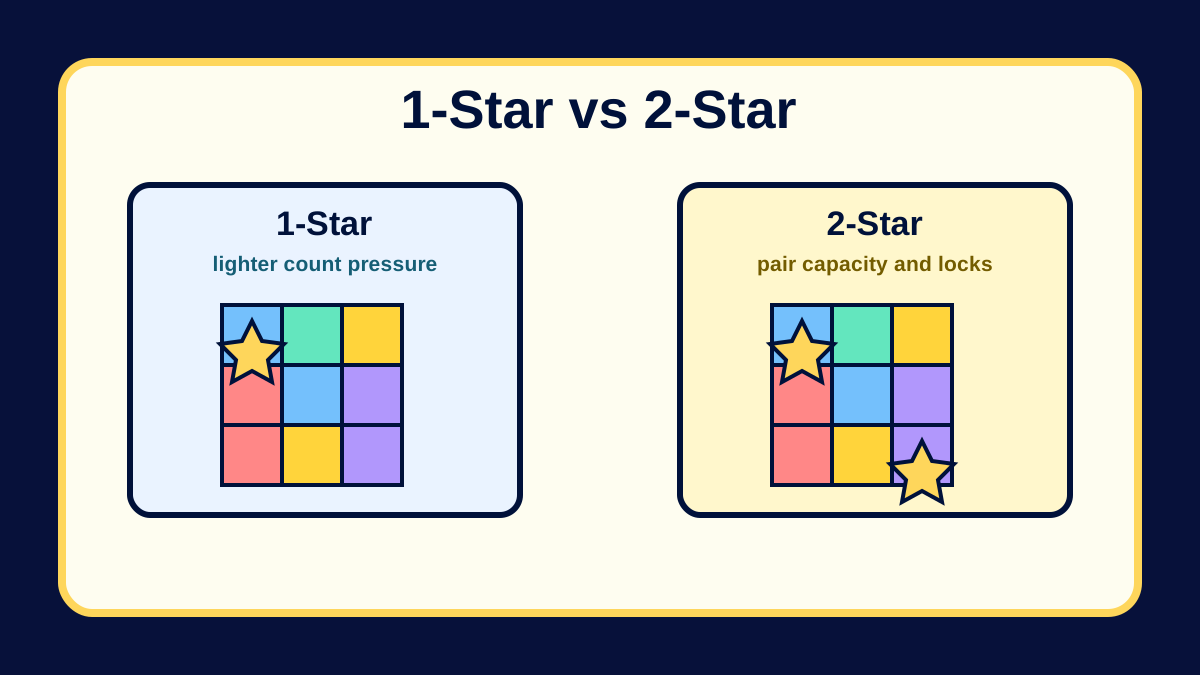
Understand how one-star and two-star Star Battle variants differ, and why starbattle.online focuses on the denser 2-star format.
Star Battle is a rule family, not a single fixed board size. Many descriptions use a general N-star rule: place N stars in every row, every column, and every region, with stars not touching. One-star and two-star puzzles therefore belong to the same family, but they play very differently.
Starbattle.online focuses on 2-star Star Battle. The goal is not to make the rules harder to remember. It is to create richer deductions from the same simple ingredients.
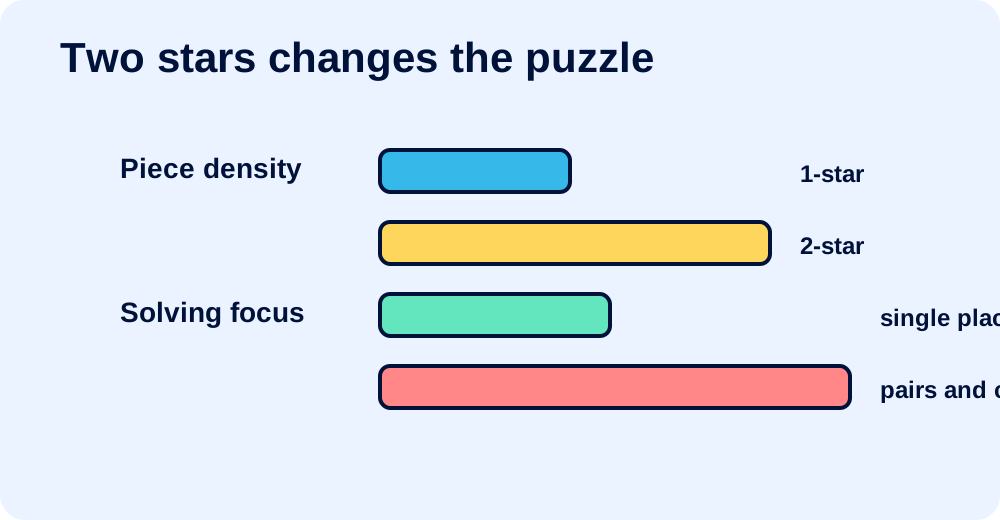
What One-Star Star Battle Feels Like
In a one-star puzzle, every row, column, and region needs one star. Once a unit has its star, it is complete. That creates a clear placement rhythm: find the only possible cell, place the star, clean up, and move on.
One-star boards are useful for learning the genre. They teach region scanning, no-touch cleanup, and forced placement without making the player track partial completion.
What Two-Star Star Battle Adds
In a two-star puzzle, every unit can be empty, half complete, or complete. This adds capacity. A row with one star still needs one more. A region with one star may be open in several places, but those places must preserve the second star's future space.
The result is a denser puzzle. More stars means more no-touch exclusions, more pair locks, and more situations where a unit is solved because exactly two legal cells remain.
Strategy Difference
One-star solving asks: where is the only legal cell? Two-star solving often asks: where can the pair fit without breaking future capacity?
That difference matters. In 2-star play, a candidate can be wrong not because it immediately violates a count, but because it leaves a row, column, or region unable to fit its second star. This is why short contradiction checks are more useful in difficult two-star boards.
Which Version Should Beginners Practice?
If you are completely new to placement puzzles, one-star boards can be a gentle introduction. But if your goal is to play this site well, practice 2-star boards early. The habits are different enough that one-star comfort does not automatically become two-star strength.
Use smaller 2-star boards first. Count every row and region out loud. Treat half-complete units as active information, not unfinished background.
Worked Example: Why Half-Complete Matters
Imagine row 6 already has one star. In a one-star puzzle, row 6 would be finished, so every other cell in the row would become impossible. In a two-star puzzle, row 6 still needs exactly one star. That means you must preserve at least one legal cell in the row while using regions and adjacency to decide which one survives.
Now imagine a region has one star and three legal cells left. A careless move in a nearby row might block two of those cells through diagonal contact. Suddenly the region has exactly one legal cell left for its second star. That kind of delayed capacity pressure barely exists in one-star play, but it is central in 2-star Star Battle.
2-Star Checklist
- For every row, track whether it needs two, one, or zero more stars.
- For every column, update capacity after each star and each X mark.
- For every region, watch for exactly two remaining legal cells.
- Never clear an entire row, column, or region after only one star.
- Always clear touching neighbors after every star, even when the unit is not complete.
Why This Site Uses 2-Star by Default
The 2-star format gives the site a stronger progression path. Beginner levels can still teach simple counting, but later boards can use pair locks, capacity bands, and dense no-touch interactions without adding new rules. That is a good trade: more depth from the same rule set, not more interface or more exceptions.
FAQ
Is 2-star Star Battle a real variant?
Yes. Star Battle variants commonly use a star count per row, column, and region. This site uses the 2-star version.
Is two-star always harder?
Usually it is denser and more demanding, but board design matters. A well-designed two-star board can still teach gradually.
Does the no-touch rule change?
No. Stars still cannot share sides or corners.
Related Guides
How to Play Star Battle
Learn the 2-star Star Battle rules, the empty-X-star click flow, and a clean first-board workflow for solving without guessing.
Star Battle Rules Explained
A precise guide to 2-star Star Battle rules: two stars per row, column, and region, with no touching stars and no long-diagonal ban.
Star Battle Strategy for Beginners
Beginner-friendly 2-star Star Battle strategy using counting, completed-unit cleanup, 2x2 limits, locked regions, and short contradiction checks.