
Advanced Star Battle Techniques
Move beyond beginner counting with region locks, row-column capacity, 2x2 neighbor nets, and controlled contradiction checks.
Star Battle
May 13, 2026
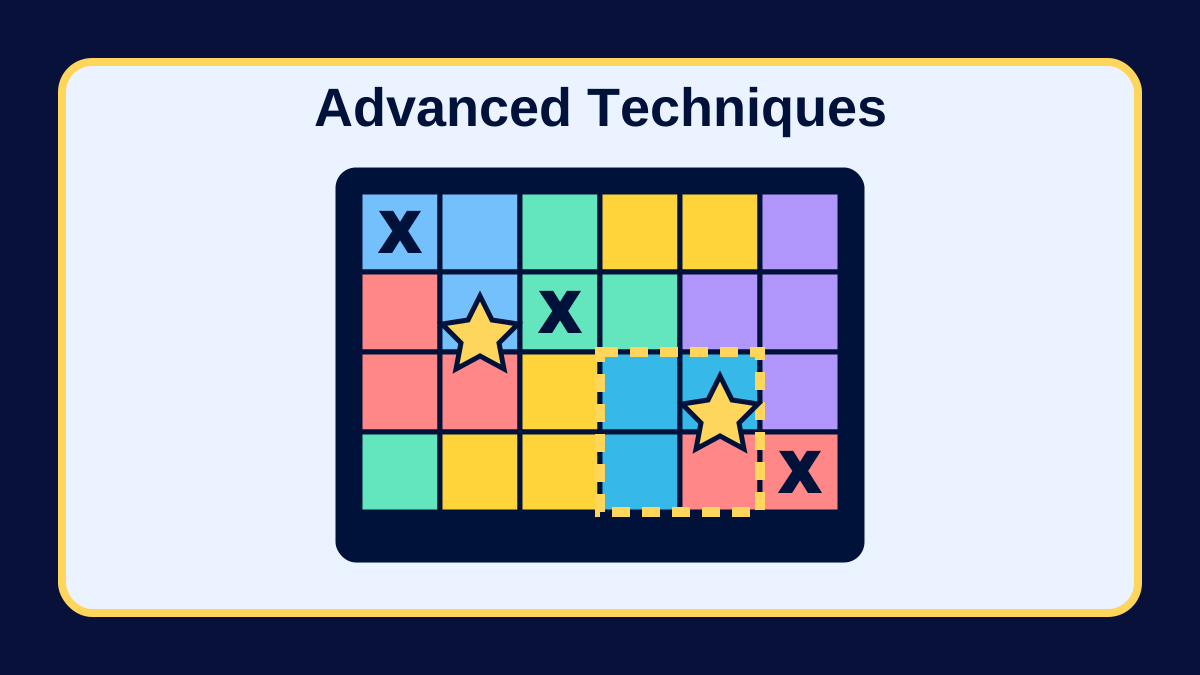
Move beyond beginner counting with region locks, row-column capacity, 2x2 neighbor nets, and controlled contradiction checks.
Beginner Star Battle strategy is mostly counting: find units with exactly two legal cells, clean completed rows and regions, and mark no-touch neighbors. Advanced play uses the same rules, but extracts information before a placement is fully forced.
The goal is still simplicity. Do not invent a theory for every board shape. Use a small ladder of techniques that can be audited from the rules.
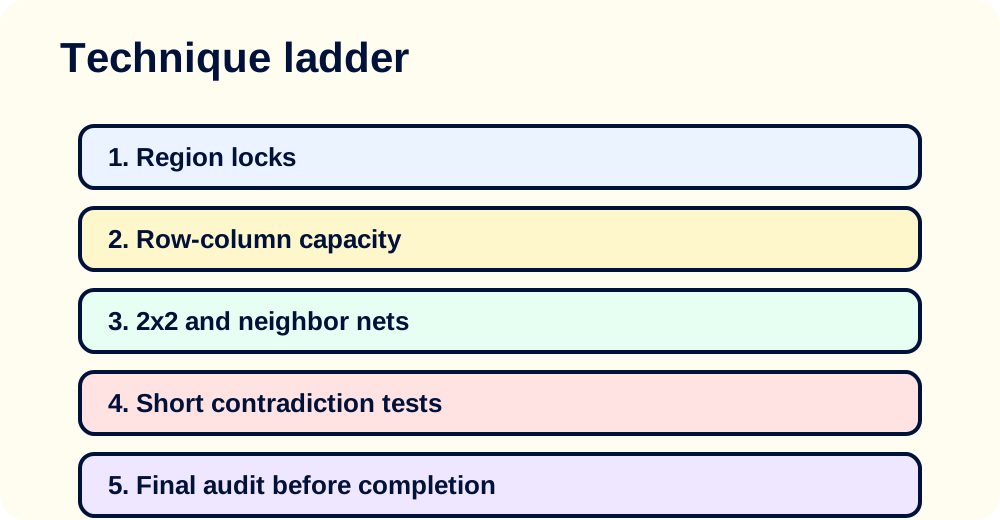
1. Region Locks
A region lock happens when a region's candidates are trapped in a limited set of rows or columns. In a 2-star puzzle, two stars must fit inside that restricted space, so the affected rows or columns lose capacity for other regions.
Do not overstate the lock. If a region's two stars must be somewhere in columns 4 and 5, you know those columns are under pressure. You do not yet know the exact cells unless the candidate count has collapsed to two.
2. Row-Column Capacity
Capacity means remaining star slots. A row with zero stars has two slots. A row with one star has one slot. A row with two stars has no slots. Advanced deductions often come from comparing required stars against remaining slots in a band of rows or columns.
If two regions both need two stars but their candidates live inside the same two rows, those rows may be fully reserved. Other candidates in those rows can become impossible.
3. 2x2 and Neighbor Nets
A 2x2 block can contain at most one star. Larger neighbor nets extend the same idea: a forced star in one of several adjacent cells can block the same outside candidate no matter which option wins.
This technique is useful near region corners. If every possible star for one region touches a cell in another region, that other cell cannot be a star.
4. Controlled Contradiction Checks
A contradiction check is valid when it is short and concrete. Assume one candidate is a star, perform immediate cleanup, and look for a unit that can no longer reach two stars.
If the test requires several branches, it is probably the wrong test. Stop and return to locks and capacity. Long speculative lines create more errors than answers.
5. Final Audit
Advanced players still make simple mistakes. Before trusting a completion, audit every row, every column, every region, and every touching pair. The board is solved only when all four checks pass.
Practice Drill
- Pick one puzzle and mark all region locks before placing any optional star.
- On the next puzzle, write the remaining capacity for each row after every placement.
- On a harder board, allow contradiction checks only when they can be resolved within one cleanup step.
Example: A Lock Without a Placement
Suppose a region still needs two stars. It has five candidate cells, but all five candidates are inside rows 3 and 4. You cannot place the stars yet, because five candidates remain. But you can still learn something: rows 3 and 4 must supply both stars for that region.
If rows 3 and 4 together already have two stars outside that region, they have only two remaining slots. Those slots are now claimed. Any other region trying to place additional stars in rows 3 or 4 may be impossible. That is the value of advanced solving: extracting a line consequence before a cell consequence.
Bad Advanced Solving
Bad advanced solving looks impressive but has no audit trail. It says "this shape usually means that cell is impossible" without proving which row, column, region, or adjacency rule forces the conclusion. Avoid that. Every advanced move should be explainable in one sentence.
A good sentence sounds like: "If this cell is a star, region 7 cannot fit its second star." Or: "These two rows have exactly two remaining slots, and this region must use both." If you cannot say the sentence, do more marking before making the move.
FAQ
Are advanced techniques just guessing?
No. A technique is useful only if it proves a specific count, lock, or impossibility.
What is the best advanced technique?
Region locks are usually the best next step after beginner counting because they create information without choosing exact cells.
When should I use contradiction checks?
Only when direct counting and locks stall, and only when the assumed star quickly creates a concrete failure.
Related Guides
How to Play Star Battle
Learn the 2-star Star Battle rules, the empty-X-star click flow, and a clean first-board workflow for solving without guessing.
Star Battle Rules Explained
A precise guide to 2-star Star Battle rules: two stars per row, column, and region, with no touching stars and no long-diagonal ban.
Star Battle Strategy for Beginners
Beginner-friendly 2-star Star Battle strategy using counting, completed-unit cleanup, 2x2 limits, locked regions, and short contradiction checks.